Table of contents
Table of contents
- The 8 best PSA software for effective client support
- 1. Atera: Best overall PSA software
- 2. ConnectWise: Standard PSA software with broad integrations
- 3. Syncro: Simple PSA software for small MSPs
- 4. Datto: Fitting for PSA with disaster recovery support
- 5. Halo: Standard PSA software with built-in CRM
- 6. SuperOps: Ideal PSA software for SMBs
- 7. Pulseway: Typical mobile-first PSA software
- 8. N-able: Ideal PSA software with integrated RMM
- Supercharge your efficiency with PSA platform powered by AI agents
- Why should you trust our reviews?
- What is PSA software?
- The importance of choosing a reliable PSA software for your MSP
- 8 key features to look for when choosing the best PSA software
Generate summary with AI

Selecting the right Professional Services Automation (PSA) tool is an important choice for IT departments and MSPs.
Ideal PSA software does more than simplify admin tasks; it also improves service delivery. It acts as a catalyst for improving collaboration between team members, ensuring that projects are completed efficiently and effectively, and improving customer service.
The best PSA tool for you and your team does not just offer a solution; it moves IT operations from reactive towards proactive IT support.
Below, we’ve reviewed the best PSA software available in 2026. Before reviewing those, we’ll share the features you should look for in PSA software, along with the benefits they can bring.
The 8 best PSA software for effective client support
Based on our research, the best PSA software in 2026 are:
- Atera – Best overall PSA software
- ConnectWise – Standard PSA software with broad integrations
- Syncro – Simple PSA software for small MSPs
- Datto – Fitting for PSA with disaster recovery support
- HaloPSA – Standard PSA software with built-in CRM
- SuperOps – Ideal PSA software for SMBs
- Pulseway – Typical mobile-first PSA software
- N-able – Ideal PSA software with integrated RMM
In 2026, the PSA software landscape is more competitive than ever. For this reason, we’ve divided the best PSA software into categories.
With that said, below is a detailed review of each of these tools.
1. Atera: Best overall PSA software
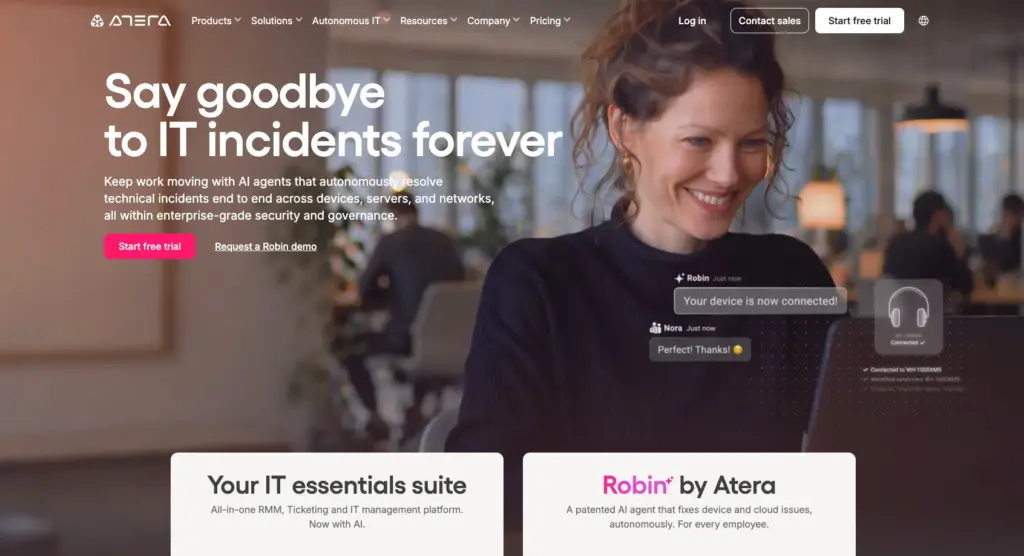
Atera’s PSA includes the essentials: helpdesk and ticketing, SLA tracking, contracts and billing module, a customer portal, and more.
While Atera includes all the essential PSA functions, where it truly distinguishes itself is through Robin, its autonomous IT agent. Robin by Atera autonomously handles up to 92% of Tier-1 and complex Tier-2 support requests, all without a technician in the loop.
While Atera includes all the essential PSA functions, where it truly distinguishes itself is through Robin by Atera, its autonomous IT agent. Robin autonomously resolves up to 92% of Tier-1 and complex Tier-2 technical incidents, with no technician in the loop.
Atera’s leap into autonomous IT gives technicians the time to focus on higher-value work that truly moves the needle. Plus, with a 0.1-second first response time and an average resolution time under 120 seconds, employees can get back to work within two minutes on average instead of waiting in a ticket queue.
Best for: IT departments and small to mid-sized MSPs that want PSA, RMM, and autonomous incident resolution in one platform.
Consider if: Atera is built for fast setup and straightforward billing, so MSPs with complex contract and procurement needs may want a dedicated PSA. [REVIEW: optional line based on third-party reviews; needs PMM approval]
Features and capabilities
In addition to PSA, Atera’s features include:
- RMM for real-time monitoring and alerting of endpoints
- Patch management for OS and third-party app updates
- Network Discovery as an add-on to find and onboard unmanaged devices
- Robin by Atera, an AI technician that resolves Tier-1 and complex Tier-2 incidents autonomously
- Remote access for connecting to endpoints directly
- AI Copilot to assist technicians
- Scripting and automation
- Asset management
Let’s take a closer look at Atera’s two distinct AI products:
- AI Copilot – Equips technicians with real-time troubleshooting help, drafted responses, and recommendations to speed up resolution times.
- Robin by Atera – Interacts with end users and autonomously resolves up to 92% of their Tier-1 and complex Tier-2 technical incidents, with no technician in the loop.
AI Copilot answers questions about your clients’ IT environments, such as:
- “Show me all tickets related to a specific asset.”
- “What were the last five changes made to our network setup?”
- “How many devices are reaching end-of-life soon?”
- “Which clients are repeatedly submitting the same types of issues?”
With Robin, organizations can resolve up to 92% of Tier-1 and complex Tier-2 technical incidents without a technician, cutting response and resolution times and freeing technicians for higher-value work. AI Copilot helps technicians resolve the incidents they still handle faster.
Customer reviews and ratings
Atera’s G2 Rating: 4.6 out of 5.0 stars (1,200+ reviews)
What Atera users are saying on G2:
- “AI is built into the entire ecosystem and responds based on knowledge base articles that we created ourselves (either internal only or externally visible for the customer),” Dieter S. says.
- “The AI agent, Robin, has been a game changer for reducing repetitive help desk work,” a G2 user says.
Atera’s Capterra Rating: 4.6 out of 5.0 stars (440+ reviews)
What Atera users are saying on Capterra:
- “Atera gives me the opportunity to maintain low overhead costs; I did find the automation function worked as expected and didn’t crash the entire dashboard,” Alison K. says.
- “The ticketing and monitoring features are useful for keeping issues organized, while patch management helps reduce the amount of manual follow-up needed,” Stacie B. says.
Pricing and value for money
Atera publishes its plan pricing, and enterprises can request a custom quotation. MSP plans range from $129 to $209 per technician per month, and IT department plans range from $149 to $219 per technician per month.
Atera prices per technician rather than per endpoint, which keeps costs predictable as you add devices and clients.
Atera’s pricing plans for IT departments:
- Professional: $149 per month, per technician
- Expert: $189 per month, per technician
- Master: $219 per month, per technician
- Enterprise: Custom quotation. Contact sales for pricing.
Atera’s pricing plans for MSPs:
- Pro: $129 per month, per technician
- Growth: $159 per month, per technician
- Power: $209 per month, per technician
- Superpower (Enterprise): Custom quotation. Contact sales for pricing.
2. ConnectWise: Standard PSA software with broad integrations
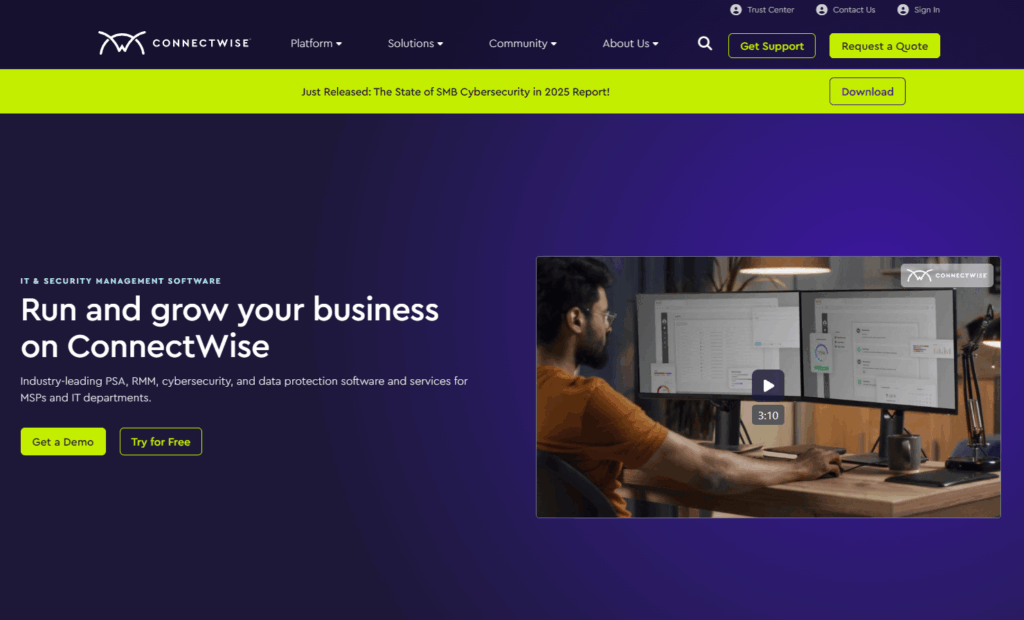
ConnectWise offers a comprehensive PSA solution for IT service providers, MSPs, and technology businesses. Known for its integration capabilities, ConnectWise connects with a wide range of third-party tools to extend workflow automation and operational efficiency.
It’s particularly suited for businesses looking for a holistic approach to managing projects, tickets, and billing, as well as integrating it with other ConnectWise products for more capabilities. ConnectWise’s newest addition is its AI Agents, which include four different ones for service desk, ticket triaging, data analysis, and oversight. Unlike Atera’s Robin, they’re not built for autonomous actions.
G2 Rating: 4.1 out of 5.0 (130+ reviews)
Capterra Rating: 4.2 out of 5.0 (130+ reviews)
ConnectWise PSA Pricing:
- Custom quotation: Available from their team upon request.
3. Syncro: Simple PSA software for small MSPs
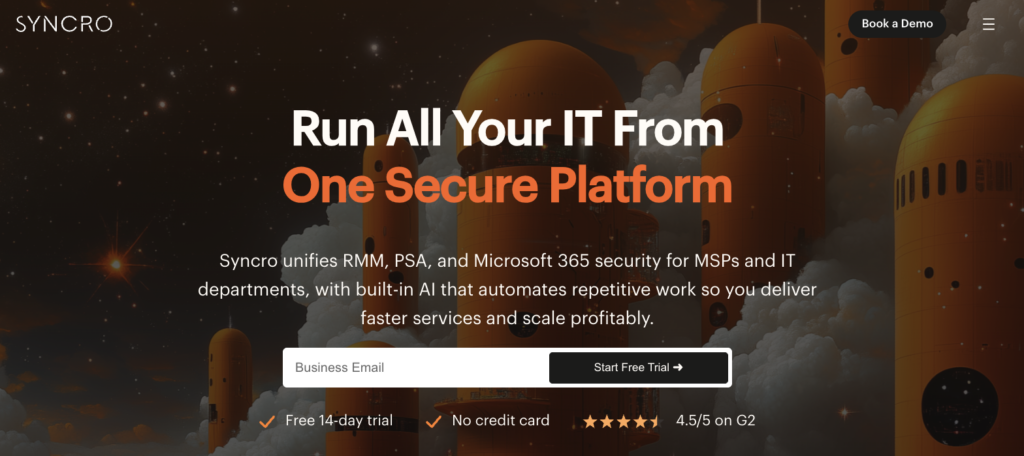
Syncro combines PSA and RMM into a single, integrated platform and is particularly suited for small MSPs. Its strength lies in providing MSPs the tools they need to manage client devices, support tickets, and billing without switching between different systems.
Syncro’s plans are priced per user, which is useful for budget-conscious MSPs. Syncro recently launched its MCP server, which lets you query your PSA data directly from your AI tool, such as Claude or ChatGPT. While useful, it isn’t designed for autonomous actions.
G2 Rating: 4.5 out of 5.0 (550+ reviews)
Capterra Rating: 4.6 out of 5.0 (140+ reviews)
Syncro Pricing:
- Core Plan: $159 per month, per user
- Team Plan: $209 per month, per user
- Enterprise: Based on a custom quotation
4. Datto: Fitting for PSA with disaster recovery support
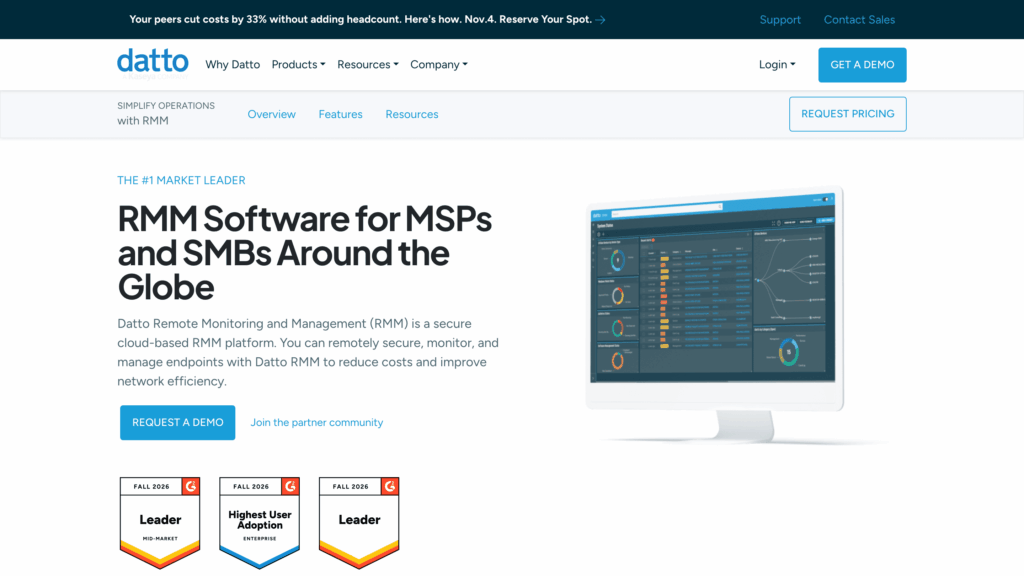
Datto is well-regarded for its data protection and business continuity solutions, alongside its PSA software.
Datto’s PSA tool is designed to help MSPs operate more efficiently. It offers features like integrated backup and disaster recovery, ticketing, and comprehensive reporting.
Datto offers Cooper Copilot (via Kaseya’s AI engine) inside of Autotask PSA, which helps to automate different service desk workflows, like ticket triaging.
G2 Rating: 4.5 out of 5 stars (540+ reviews)
Capterra Rating: 4.1 out of 5 stars (25+ reviews)
Datto Pricing:
- Custom pricing available. Contact Datto’s sales team to get the pricing.
5. Halo: Standard PSA software with built-in CRM
Halo (formerly HaloPSA) offers a flexible and fully customizable PSA solution with a built-in CRM for managing customer relationships, sales pipelines, and communication history.
Its feature set includes ticketing, CRM, project management, and service catalogs, all configurable to fit specific business processes. HaloPSA is ideal for organizations seeking a tailor-made solution to support their unique workflows.
Note: Halo had a big update recently as it rebranded its standalone PSA tool “HaloPSA” to “Halo”, a single platform that covers ITSM, CSM, CRM, and ESM under one license.
G2 Rating: 4.6 out of 5.0 stars (40+ reviews)
Capterra Rating: 4.8 out of 5.0 stars (40+ reviews)
HaloPSA Pricing:
- With the rebrand, Halo’s pricing also had a slight change. It now starts at $99/month per agent. An onboarding package is also required with purchase.
6. SuperOps: Ideal PSA software for SMBs
SuperOps brings modern technology to SMBs with its AI-driven PSA and RMM platform. For its PSA capabilities, it includes a service desk, contract management, event scheduling, service automation, and knowledge-base management.
It focuses on automation, AI, and real-time insights to streamline operations and enhance decision-making. SuperOps’s newest addition is its “AI marketplace” for MSPs, which can be used to select ready-to-use agents for IT workflows.
G2 Rating: 4.4 out of 5.0 stars (200+ reviews)
Capterra Rating: 4.6 out of 5.0 stars (60+ reviews)
SuperOps Pricing:
- Prime: Starting at $1.50/endpoint for a minimum of 100 endpoints
- Prime Plus: Starting at $2.50/endpoint for a minimum of 150 endpoints
7. Pulseway: Typical mobile-first PSA software
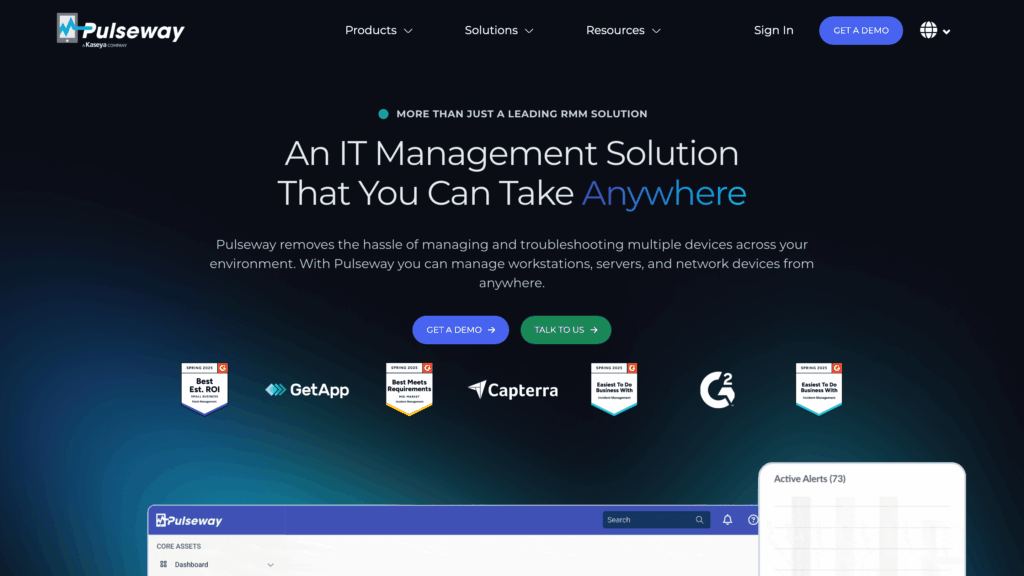
Pulseway is known for its remote monitoring and management capabilities, paired with an effective PSA solution. It’s an industry leader in mobile-first PSA, as the mobile app allows you to manage tickets, create knowledge base articles, access end-user devices remotely, and deploy patches.
In 2026, Pulseway introduced Pulseway Assist into the platform, helping to summarize tickets and draft responses.
G2 Rating: 4.5 out of 5.0 (120+ reviews)
Capterra Rating: 4.7 out of 5.0 (305+ reviews)
Pulseway Pricing:
- Basic: Custom pricing available. Consult their website to learn more.
8. N-able: Ideal PSA software with integrated RMM
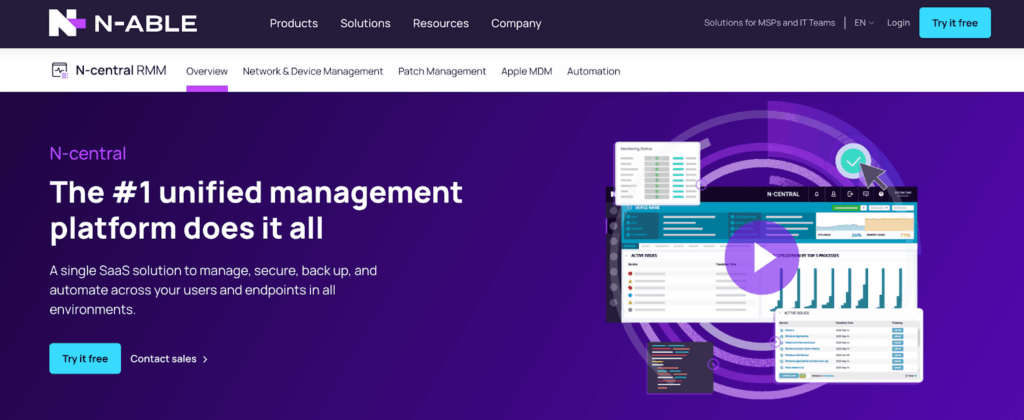
N–able offers a suite of cloud-based software solutions, including a powerful PSA tool, N‑able MSP Manager, designed to help MSPs and IT service providers optimize their operations.
When integrated with N-central, MSPs get access to both PSA and RMM features, although it means paying for two separate subscriptions.
Like many others, N-able has recently entered the agentic AI space with its N-zo AI coworker, launched in April 2026.
G2 Rating: 4.4 out of 5.0 stars (560+ reviews)
Capterra Rating: 4.2 out of 5.0 stars (250+ reviews)
N-central Pricing:
- The company does not publicly disclose its pricing. Request a quote via the website.
Supercharge your efficiency with PSA platform powered by AI agents
The selection of the right PSA software is a critical decision that impacts operational efficiency and positions an MSP for future growth. Integrating a comprehensive PSA system streamlines workflows and enhances productivity, offering significant long-term benefits.
For those looking to make a strategic choice, explore Atera. With Robin by Atera, you can autonomously resolve up to 92% of your Tier-1 and complex Tier-2 technical incidents, all without a technician having to get involved.
If this sounds interesting, an easy step you can take is to sign up for Atera’s 30-day free trial, or get in touch with our sales team to discuss your needs further.
Why should you trust our reviews?
Atera publishes this list, and we rank Atera first. We don’t just list any tools: we do our own research and look at verified reviews on platforms like G2, Capterra, and Reddit to see what other IT professionals use and recommend. For each tool, we explain what it’s best at, its key features, customer reviews, and pricing so you can make the best decision for your IT team
What is PSA software?
PSA software addresses critical issues such as fragmented workflows, ticket and project management difficulties, and inaccuracies in billing.
A PSA system is designed to cover all team management functionalities crucial for running an efficient IT support department. These functionalities include:
- Allocating tasks among team members effectively
- Monitoring the progress and completion of tasks
- Recording the resources expended on projects
- Utilizing forecasting to pinpoint areas requiring additional resources
- Reporting on the achievement of goals tied to SLAs
- Conducting audits to ensure compliance with data integrity standards
Modern PSA platforms combine this with Agentic AI for autonomously handling tasks like incident management.
The importance of choosing a reliable PSA software for your MSP
So, what are the benefits of using PSA software for your organization? Let’s just say, there are many benefits, and we’ve outlined the main ones below.
1. Streamlined workflows
The capacity of PSA software to streamline workflows cannot be overstated.
After all, they help to automate tasks like responding to tickets and automatically categorizing them, tracking project progress, and generating reports.
Some platforms, like Atera, go even further. Atera’s AI technician, Robin, resolves Tier-1 and complex Tier-2 incidents end to end, taking action directly on devices, servers, and networks without a technician needing to step in.
2. Improved resource allocation
Optimal resource allocation is another hallmark of top-tier PSA solutions. These systems provide real-time visibility into project demands and staff availability, enabling managers to assign tasks based on skillset and workload effectively.
3. Refined client service operations for MSPs
MSPs find immense value in the specialized capabilities of PSA software. These platforms help to manage client interactions, track service histories, monitor SLAs, and centralize communication.
This holistic management ensures the delivery of consistent, superior services, directly impacting client satisfaction and loyalty.
4. Operational excellence
Integrating core functions of project management, service delivery, and client engagement onto a single platform allows for a unified approach to business operations. This consolidation is pivotal for businesses aiming to enhance efficiency.
8 key features to look for when choosing the best PSA software
When you’re choosing a PSA software for your MSP, several features stand out that you should prioritize:
1. All-in-one platforms
All-in-one platforms simplify IT management by integrating various functionalities, such as PSA, ticketing, time tracking, RMM, and remote access, into a single tool.
This integration is particularly beneficial for IT departments and MSPs, providing a unified approach to managing client support and internal projects.
2. IT automation
Automation capabilities within PSA software eliminate repetitive tasks, streamline workflows, and enhance service delivery. The right solution automates everything from ticket routing to billing, significantly reducing manual effort and increasing accuracy.
3. Agentic AI capabilities
Most platforms already offer generative AI, but when talking about agentic platforms, there’s a real difference between hype and real autonomous IT.
Generative AI suggests; it summarizes tickets and writes scripts for a technician to review. Agentic AI within autonomous service desk diagnoses issues, acts directly on the device or system, and closes the ticket.
4. Broad integrations
Extensive integrations are especially important for larger MSPs with 100s of clients. The right PSA solution should connect with your existing technology stack, including CRM systems, accounting software, RMM, MDR, cybersecurity, and more, ensuring data flows freely across your organization.
If AI agents are available, integrations for that are also important. For example, Robin by Atera integrates with 50+ tools, so it works wherever your IT already lives.
5. Advanced customization
Every organization has unique needs. A customizable PSA platform allows you to change things like ticket workflows, user roles, service catalogs, notification rules, and dashboard layouts, so the system aligns perfectly with how your team works.
6. Effortless onboarding
Simple onboarding of new users to the PSA platform is vital. Not only does this make it easy for you, but also for all future technicians and end users.
7. Transparent pricing
The cost and pricing structure of PSA software differ significantly. Some solutions are priced per-agent; some use pay-per-endpoint pricing as part of their PSA/RMM software.
For a growing MSP, that difference can change your costs significantly as you add clients.
8. Reliable customer service
To support onboarding (and any troubleshooting later on), reliable customer service is key. Fortunately, you can find PSA software with 24/7 support and extensive knowledge bases in 2026.
Frequently Asked Questions
Related Articles

Elevate your MSP with the best PSA software of 2026
Comparing PSA software for MSPs in 2026? See why an all-in-one platform with autonomous IT beats stitched-together tools.
Read now
Maximize SLA Compliance with Business Hours and Holidays
Maximize SLA compliance with Atera’s customizable business hours and holiday scheduling. Set accurate service windows, avoid breaches, and improve client satisfaction. Start your 14-day free trial today!
Read now
Best infrastructure monitoring tools for IT reliability and performance
Looking for the best infrastructure monitoring tool? Compare the best ones, their key features, pricing, and the pros and cons.
Read nowEndless IT possibilities
Boost your productivity with Atera’s intuitive, centralized all-in-one platform